Trump goes to war with the pope
- Apr 15
- 4 min read
PUBLISHED: April 13, 2026 | www.baltimoresun.com
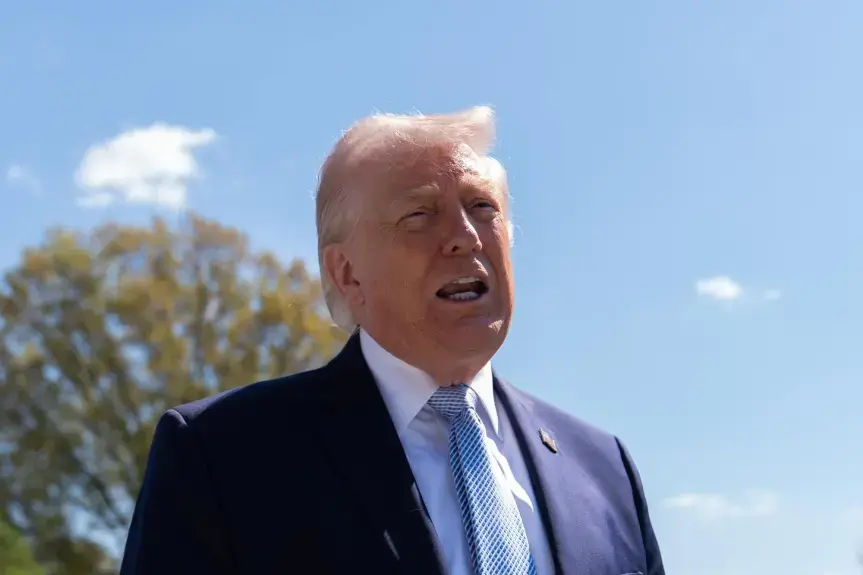
There are moments in political life when rhetoric stops being merely provocative and begins to test the boundaries of institutional respect. What we are witnessing with President Donald Trump’s attack on a sitting pope invites comparison to one of the most consequential overreaches in modern American history, when Sen. Joseph McCarthy turned his fire on the U.S. military and exposed the limits of demagoguery.
That parallel is not casual. It is instructive.
But for those in Baltimore and across Maryland, this moment carries an even deeper resonance.
Maryland is not just another state with a Catholic population — it is the birthplace of Catholicism in America. The Baltimore Basilica, the first Catholic cathedral in the United States, stands as a symbol of religious freedom and the enduring role of faith in American public life. From the earliest days of the republic, Maryland has been shaped by Catholic thought, leadership and community institutions that helped define the nation’s commitment to religious liberty.
That history matters now.
McCarthy’s downfall did not come because he lacked support. At his height, he commanded headlines, shaped fear and influenced national discourse. His collapse came when the American public recognized that there are certain institutions, pillars of national and moral life, that cannot be casually politicized without consequence. When he attacked the military, he crossed from aggressive politics into recklessness. The famous rebuke — “Have you no sense of decency?” — was a moment when the country reclaimed its moral footing.
Today, the question is whether a similar line is being approached.
Trump’s criticism of a pope is not, in itself, disqualifying. In a free society, religious leaders are not beyond critique, particularly when they engage in moral or social debates that intersect with public policy. The Catholic Church has long been a voice on issues of war, poverty, migration and human dignity. Disagreement is not only inevitable; it is healthy.
But tone, intent and context matter.
When a political leader frames a pope not as a moral interlocutor but as a political adversary, something deeper is at play. This is no longer a policy disagreement; it becomes an effort to recast a spiritual authority through the lens of partisan conflict. Language that suggests weakness or illegitimacy signals not engagement, but confrontation.
And that raises a more profound question: What is the objective?
At one level, it reflects a broader strategy — disrupt, challenge and redefine institutions that stand outside political control. Whether it is the judiciary, the media or now a global religious figure, the pattern is consistent. Institutions are not merely debated; they are reframed as adversarial if they do not align.
But the Catholic Church is not just another institution.
It is a global body of more than a billion adherents, with deep roots in communities like Baltimore, where Catholic parishes, schools, hospitals and charities have long served as anchors of stability and service. For generations of Maryland families, the Church has not been an abstract institution; it has been a lived presence in education, health care and community life.
When political power seeks to diminish that moral authority, the risk is not simply backlash; it is division within communities that have long relied on the Church as a source of unity.
For American Catholics, this moment is delicate. Many have supported Trump politically; others have been deeply critical. The pope, in principle, exists above those divisions. An attack like this risks forcing a choice between political loyalty and spiritual allegiance, an uncomfortable and potentially destabilizing proposition.
That is where the McCarthy analogy becomes more than rhetorical. He misjudged not only the institution he targeted, but the public’s tolerance for such attacks. Trump, in this instance, may be testing a similar boundary, whether Americans, including millions of Catholics in states like Maryland, are willing to accept the politicization of a spiritual authority on this scale.
Has he crossed the Rubicon?
Not definitively, but he is standing at its edge.
Crossing the Rubicon is not a single act; it is a point of no return, a shift in how power is exercised and restrained. Whether this moment becomes such a turning point depends on the response.
If supporters embrace this framing, the boundary moves. If they resist it, if they insist on the distinction between critique and contempt, then the moment becomes corrective rather than transformative.
What is needed now is moral clarity.
Moral clarity does not require agreement with the pope on every issue. Nor does it demand silence in the face of disagreement. It requires discipline, the ability to distinguish between debate and delegitimization, between disagreement and disrespect.
It also requires an honest question: Is this about policy, or is it about consolidating influence by redefining every independent authority as opposition?
For a city like Baltimore, and a state like Maryland, where the roots of American Catholicism run deep, that question carries particular weight. The strength of our institutions depends on our willingness to protect their integrity, even in moments of political intensity.
McCarthy’s moment ended when the country decided enough was enough.
This moment is still unfolding.
Armstrong Williams (www.armstrongwilliams.com; @arightside) is a political analyst, syndicated columnist and owner of the broadcasting company, Howard Stirk Holdings. He is also part owner of The Baltimore Sun.
©️ 2026 Baltimore Sun


Comments